Nothing is releaseduntil it is traced.
DjiniousEngineering is an AI systems engineer. Hand it a handful of specifications and it carries the system to a manufacturing or deployment data package — deriving requirements, trading architectures, sizing the design and closing verification. Each project is a System Ledger: the digital thread, worked stage by stage, and stopped at every review gate for a human.
- Frame
- Design
- Prove
- Release


A systems-engineering platform, not a document template
Everything the lifecycle needs, in one product with one data model — so there is no seam between the requirement you derive, the component it is allocated to, and the verification that closes it.
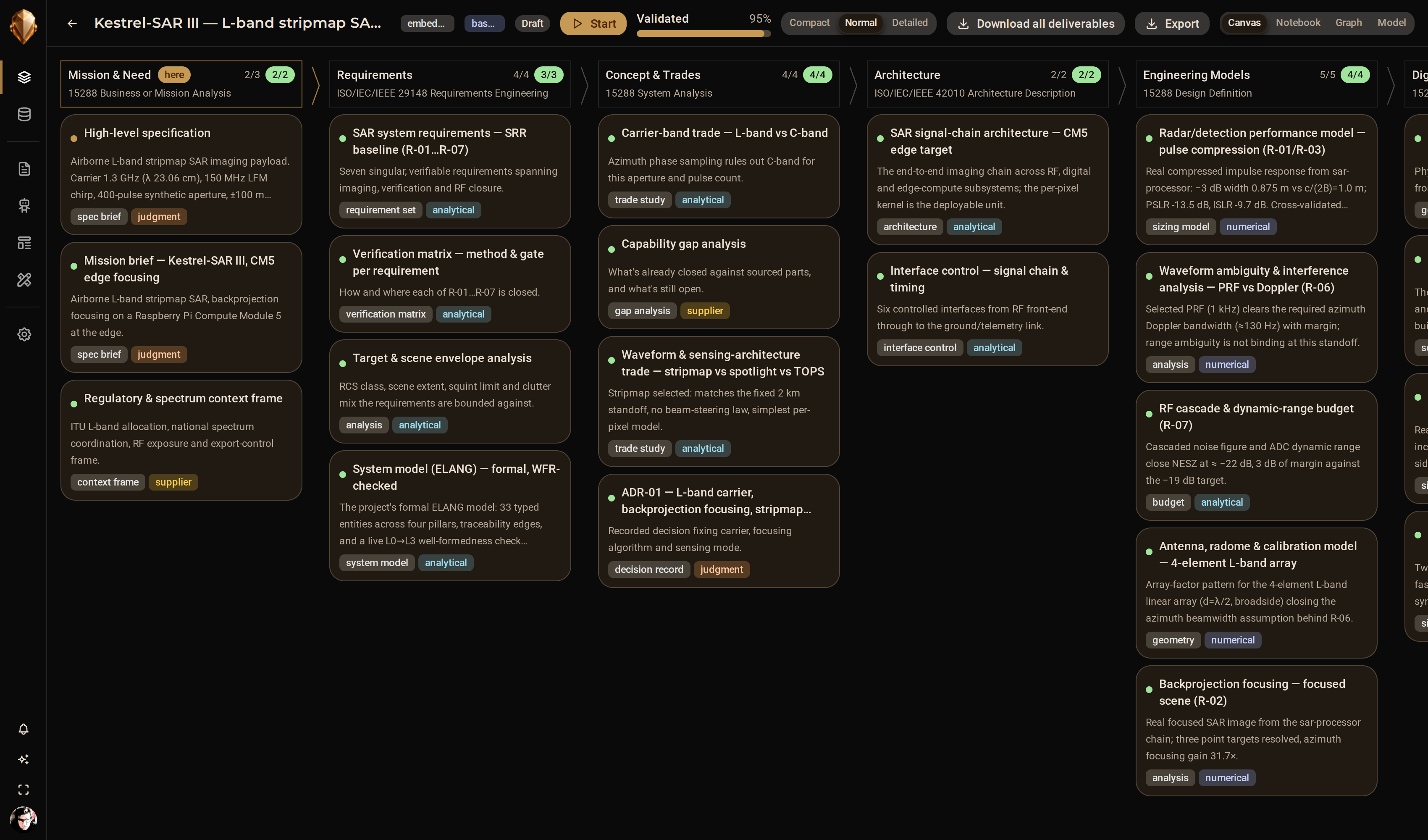
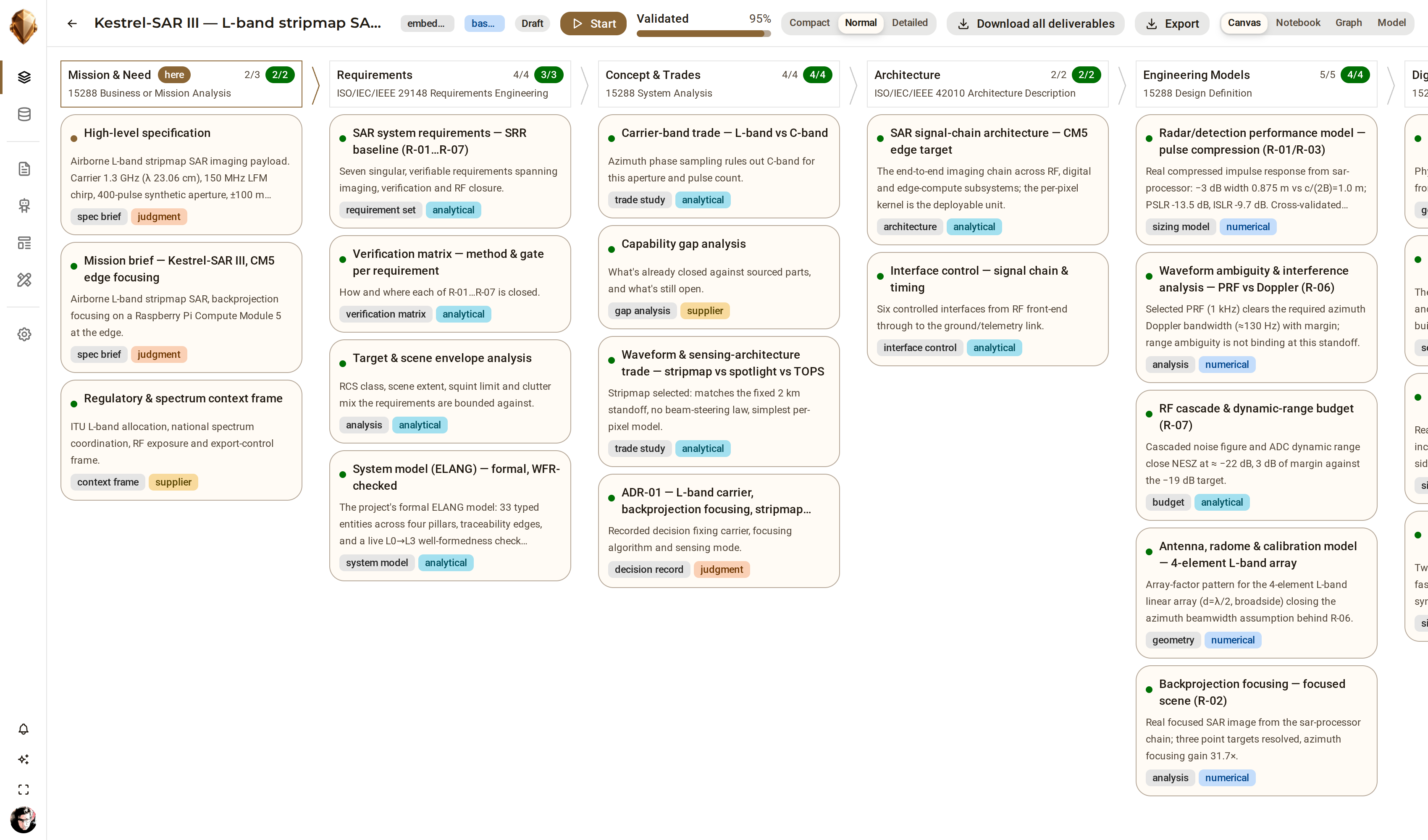
System Ledger canvas
ISO/IEC/IEEE 15288The digital thread as eleven stage columns. Every item carries an artifact type, an evidence class, a revision and a validation state; revising one marks everything downstream stale.
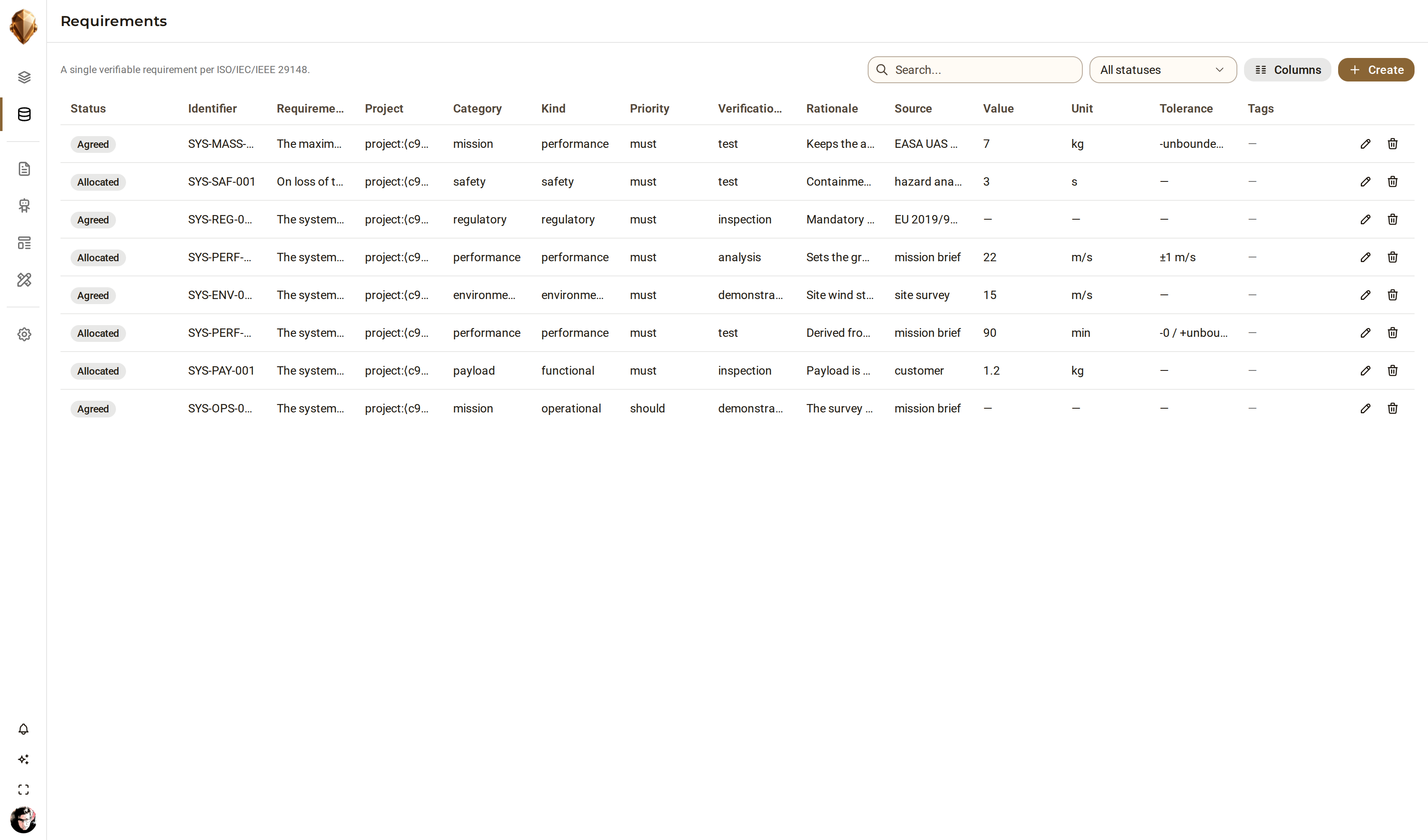
Requirements & traceability
ISO/IEC/IEEE 29148Requirements derived from needs, allocated onto components, sourced from suppliers, and closed by verification — all as graph edges you can walk, not links kept by hand.
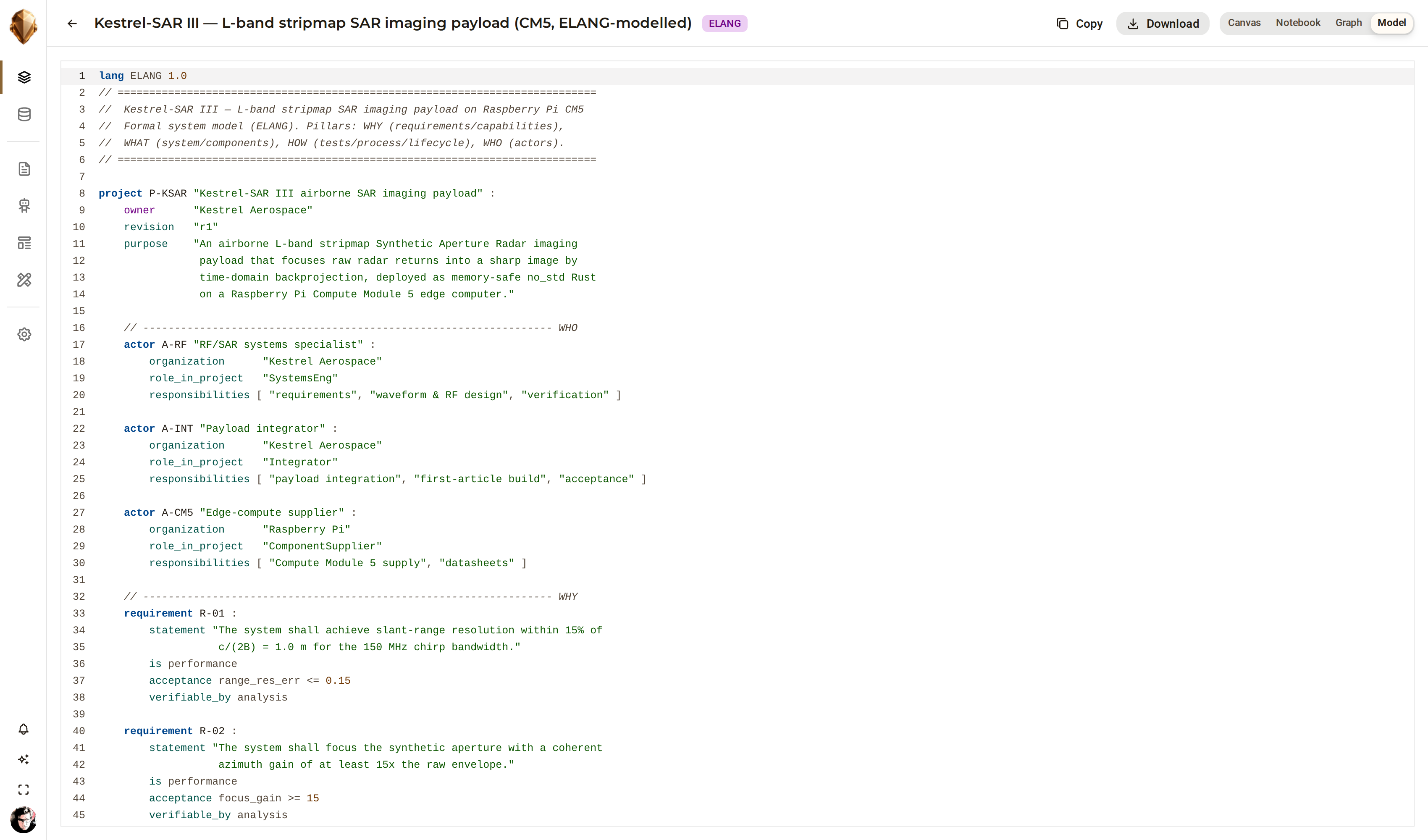
The ELANG model
CONFORMANCE L0–L3One machine-checkable model of the whole system across four pillars and twenty-seven entity kinds, checked against twenty-six well-formedness rules, with its gaps listed.
Review gates
SRR · PDR · CDR · TRR · PRRFive gates the agent evaluates but only a person passes. Each blocks the run until the items upstream are user-validated and the criteria are met.
Supply chain & BOM
MAKE-OR-BUYA bill of materials with make-or-buy, lead times, second sources and risk, reaching the shared component library — because CDR will not pass without a qualified source on every part.
Technical Data Package
GENERATED FROM THE THREADThe release artifact — baseline, procedures and evidence — generated from the validated ledger and exported as a document bundle, not written up alongside it.
One licence. One program. Nothing metered.
DjiniousEngineering is licensed per program — one organization's engineering work — not per requirement, per seat or per project. Add engineers, open more projects, run more agents, connect more of the platform: the licence does not change. Nobody should be rationing requirements or projects because of a licence.
- Projects (System Ledgers)Unlimited
- Ledger itemsUnlimited
- ELANG modelsUnlimited
- Agent runsUnlimited
- Connectors & API tokensUnlimited
- SeatsUnlimited
What a document-and-spreadsheet toolchain leaves you to solve
We do not name tools, and we do not claim every program has every one of these problems. These are the properties of the category as most engineering programs run it today.
| Axis of comparison | Conventional systems engineering | DjiniousEngineering |
|---|---|---|
| Traceability | Requirements in a spreadsheet, links to design kept by hand | Derive, allocate and verify as graph edges the platform maintains |
| The model | A pile of documents that drift apart the moment they are written | One ELANG model, checked against twenty-six rules, at a stated conformance level |
| Evidence | A cell that says a requirement is met | A typed evidence class; UNKNOWN evidence cannot close a requirement |
| Review gates | A meeting and a slide deck | A gate the agent cannot pass until a human validates the evidence upstream |
| Change | Chase the ripples of a change through the documents by hand | Change an item and everything downstream is marked stale automatically |
| AI | None, or a chatbot bolted on the side | An agent that works the ledger under policy and stops at every gate |
The change row is the one worth arguing about. A toolchain that does not know what a change touched is telling you a baseline is current when it is not.
A ledger, not a folder of documents
A document-based toolchain leaves you a set of files and the job of keeping them consistent. DjiniousEngineering holds the system as a ledger of typed items connected by produces-edges — the digital thread — with an ELANG model over the top. This is what a document toolchain does not give you, and it is why the rest of the loop is possible at all.
- Typed items — thirty artifact types — each with an evidence class, a revision and a validation state
- Connected by produces-edges into a DAG, so a change's blast radius is computed, not guessed
- An ELANG model across four pillars, checked against twenty-six well-formedness rules
- The whole thing navigable over REST and a single MCP endpoint, by people and by agents


Four beats, and a gate a human has to hold
This is the whole product. Everything else — the ELANG model, the traceability graph, the recipes, the connectors — exists to make one of these four beats true, and to make the gate between intent and release real.
- 01
A mission need becomes requirements you can verify
The agent grounds the specifications, then derives requirements that are singular and verifiable, each with a verification method and a place in the hazard list. The requirement baseline has to hold at SRR before any design proceeds.
- Requirements engineered to ISO/IEC/IEEE 29148 — singular, verifiable, each with a method
- Every requirement derives from a stated need, as a graph edge, not a citation
- The initial hazard list exists before the gate opens
- SRR blocks the run until a human validates the requirement baseline
- 02
Trades, architecture, and a sizing loop that converges
Candidate architectures are traded against weighted criteria, the decision is recorded, and requirements are allocated onto the components that implement them. The sizing loop runs until the margins against every hard constraint are positive.
- Trade studies scored on explicit, weighted criteria with a recorded decision
- Architecture described to ISO/IEC/IEEE 42010; requirements allocated onto components
- The sizing loop converges; margins against every hard constraint are positive
- PDR blocks the run until the design baseline is validated
- 03
Evidence closes a requirement — not an assertion
Verification activities close requirements, and each carries a typed evidence class. Nothing closes a requirement on JUDGMENT when its method demands MEASURED, and a requirement resting on UNKNOWN evidence cannot close at all.
- Eight evidence classes, MEASURED strongest to UNKNOWN weakest, enforced on closure
- A verification activity stands behind every requirement, traced by a verifies edge
- The digital replica correlates with the analytical models before TRR opens
- Safety and assurance carried as first-class obligations, not an appendix
- 04
A baseline a reviewer could follow
Geometry, BOM and software freeze into a released baseline, and the Technical Data Package is generated from the validated thread. Change any released item and everything downstream of it goes stale — the baseline cannot drift out from under a passed gate.
- CDR requires a released baseline with a qualified source and lead time on every part
- The Technical Data Package is generated from the thread, not typed up beside it
- PRR requires the TDP complete and internally consistent
- Superseding a released item takes a written reason a reviewer reads first
A stage only closes when a human validates it
Five review gates sit between the stages. Each is a ledger item the agent cannot pass until the items upstream of it are user-validated and the platform's criteria are met — which is what stops an autonomous run from designing on top of an unreviewed baseline.
| Gate | Review | After stage | What it checks |
|---|---|---|---|
| SRR | System Requirements Review | Requirements | Every requirement is singular and verifiable, each has a verification method, and the initial hazard list exists. |
| PDR | Preliminary Design Review | Engineering Models | The sizing loop has converged and the margins against every hard constraint are positive. |
| CDR | Critical Design Review | Supply Chain | Geometry, BOM and software baseline are released, and every part has a qualified source and a lead time. |
| TRR | Test Readiness Review | Verification & Validation | The digital replica correlates with the analytical models, and abort criteria and safety cases are agreed. |
| PRR | Production Readiness Review | Baseline Release | The Technical Data Package is complete and internally consistent. |
A gate is a ledger item the agent cannot pass until the items upstream are user-validated and the criteria are met — which is what stops an autonomous run from designing on an unreviewed baseline.
The lifecycle does not care what the system is
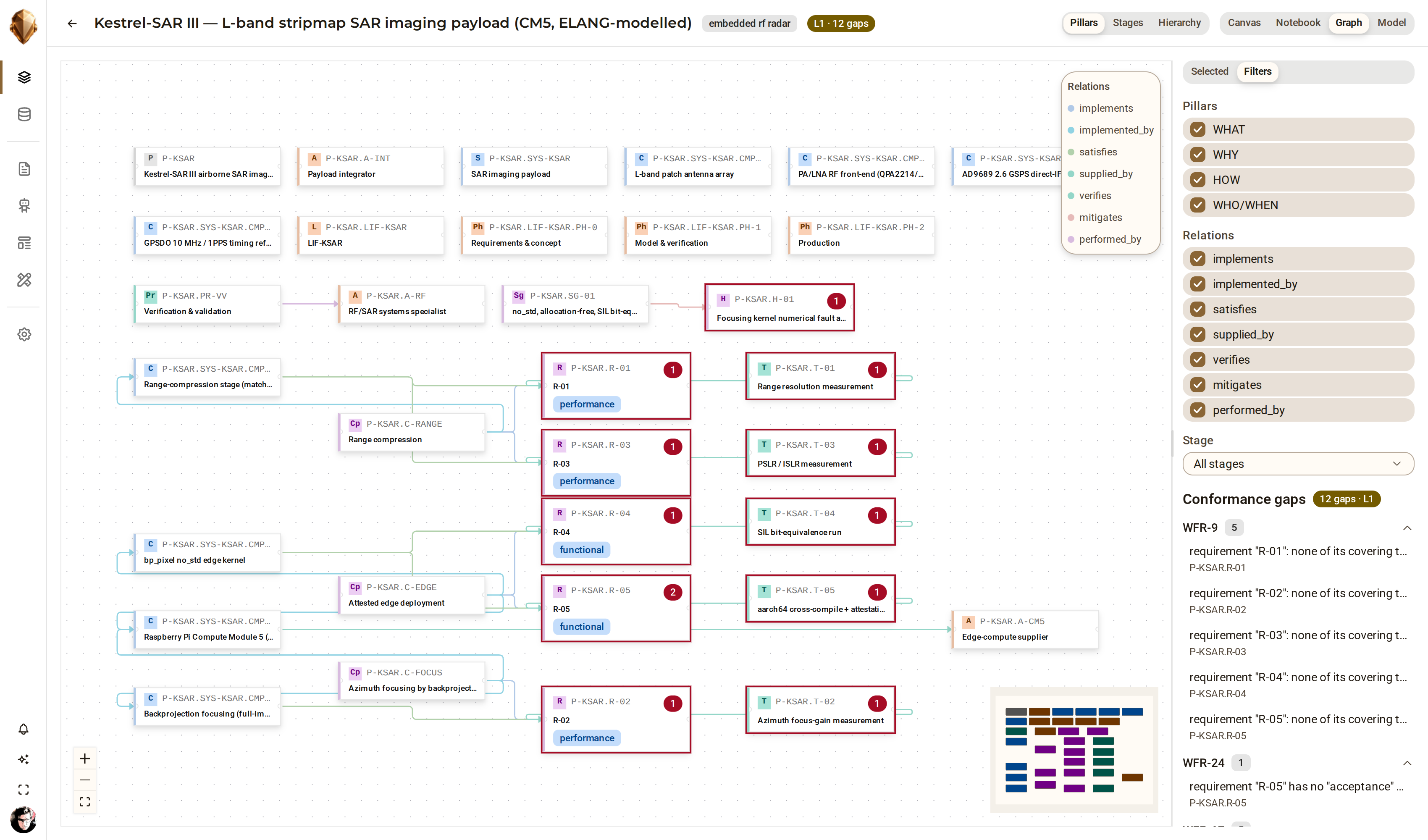
The same eleven stages, the same gates and the same ELANG model run an underwater survey vehicle, a survey UAV, a robotic work cell, a grid-scale solar-storage plant or an embedded radar module. Two are live in the platform; three are the audited ELANG reference models shipped in the repo.
 MRLN-XRSubsea autonomy
Marlin-XR Seabed Survey AUV
An autonomous underwater vehicle surveying the export-cable corridor of the Dogger Bank offshore wind farm. The bundled demo ledger: forty items seeded across all eleven lifecycle stages, from the mission brief to the deployment procedure.
40 items · 11 stagesRead the case →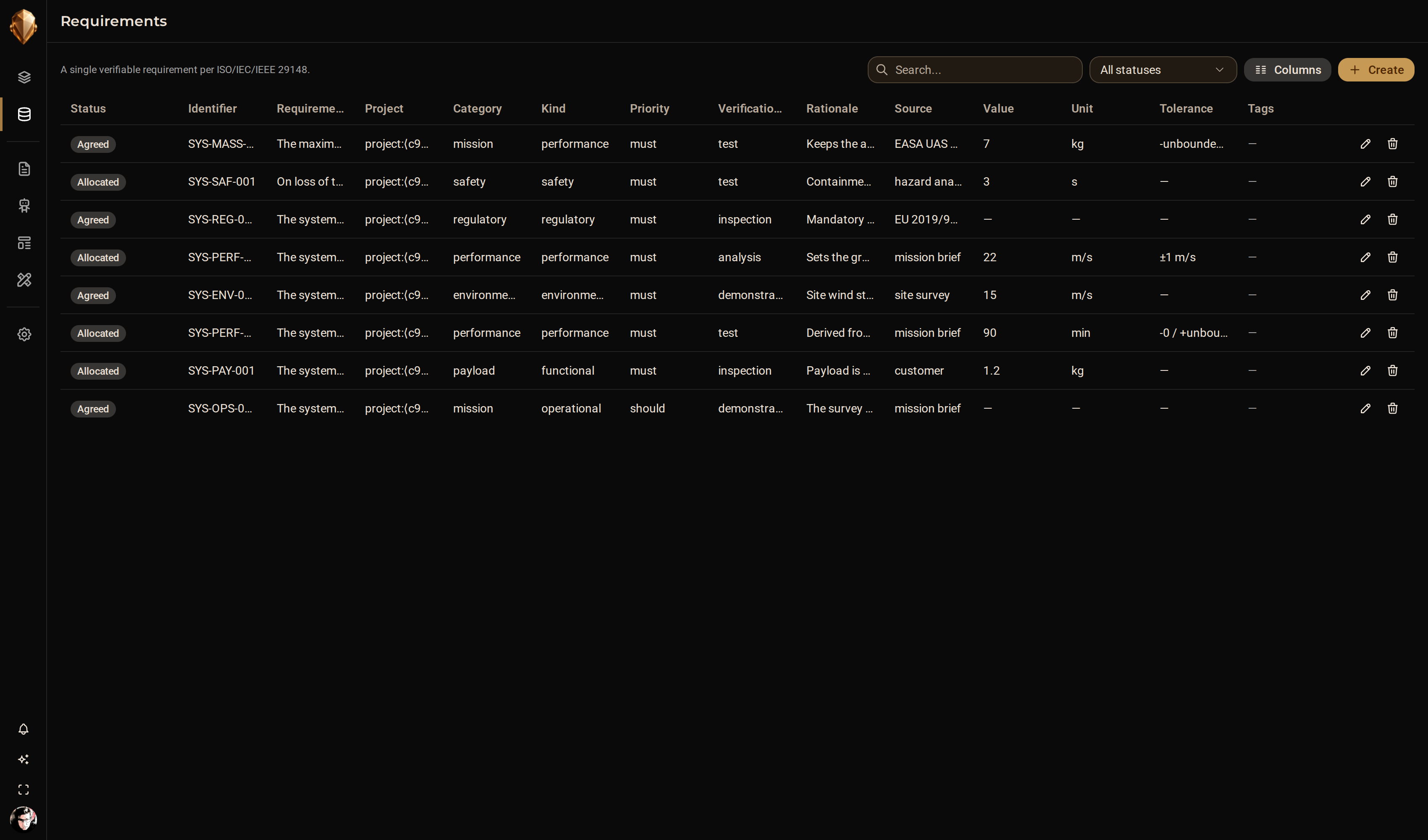
 KSTL-1Uncrewed aircraft
Kestrel-1 Survey UAV
A fixed-wing survey UAV, seeded as a worked example: eight requirements, six components, four suppliers and four verifications, wired into a traceability graph, with a real ELANG system_model and an inline Technical Data Package.
Worked exampleRead the case →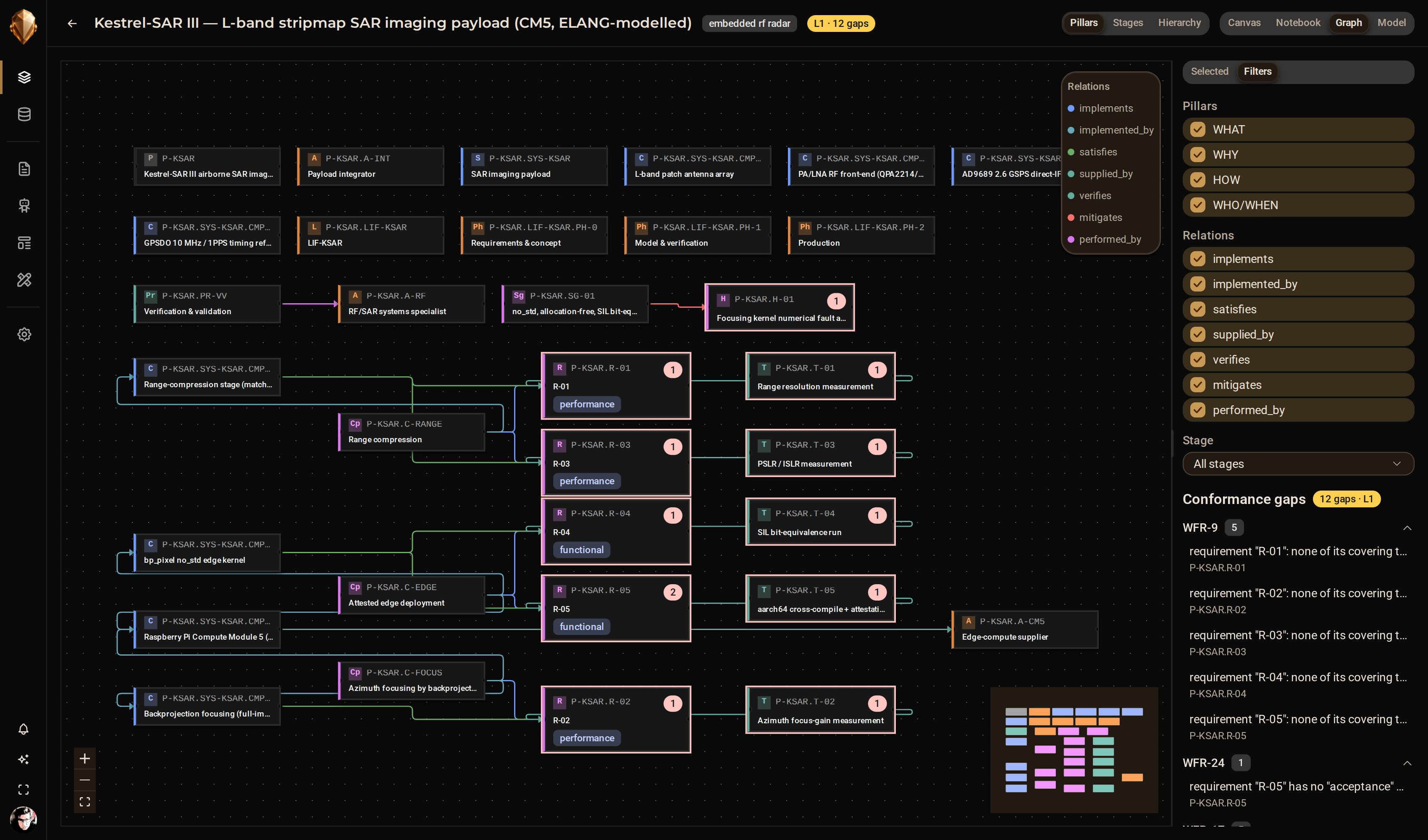
 KRNSIndustrial robotics
Kronos Robotic Work Cell
A six-axis robotic work cell modelled end to end in ELANG as an audited reference — roughly a thousand lines carrying a functional-safety design to ISO 13849-1 Performance Level d, with every safeguard traced to the hazard it mitigates.
ELANG reference modelRead the case →- SG80Grid-scale energy
SunnyGrid80 Solar-Storage Plant
An 80 MW photovoltaic plant with a 40 MW / 80 MWh battery energy-storage system and its grid substation, modelled in ELANG as an audited reference to UL 9540A and IEC 62443 — a system-of-systems where the interfaces carry as much of the design as the boxes.
ELANG reference modelRead the case → 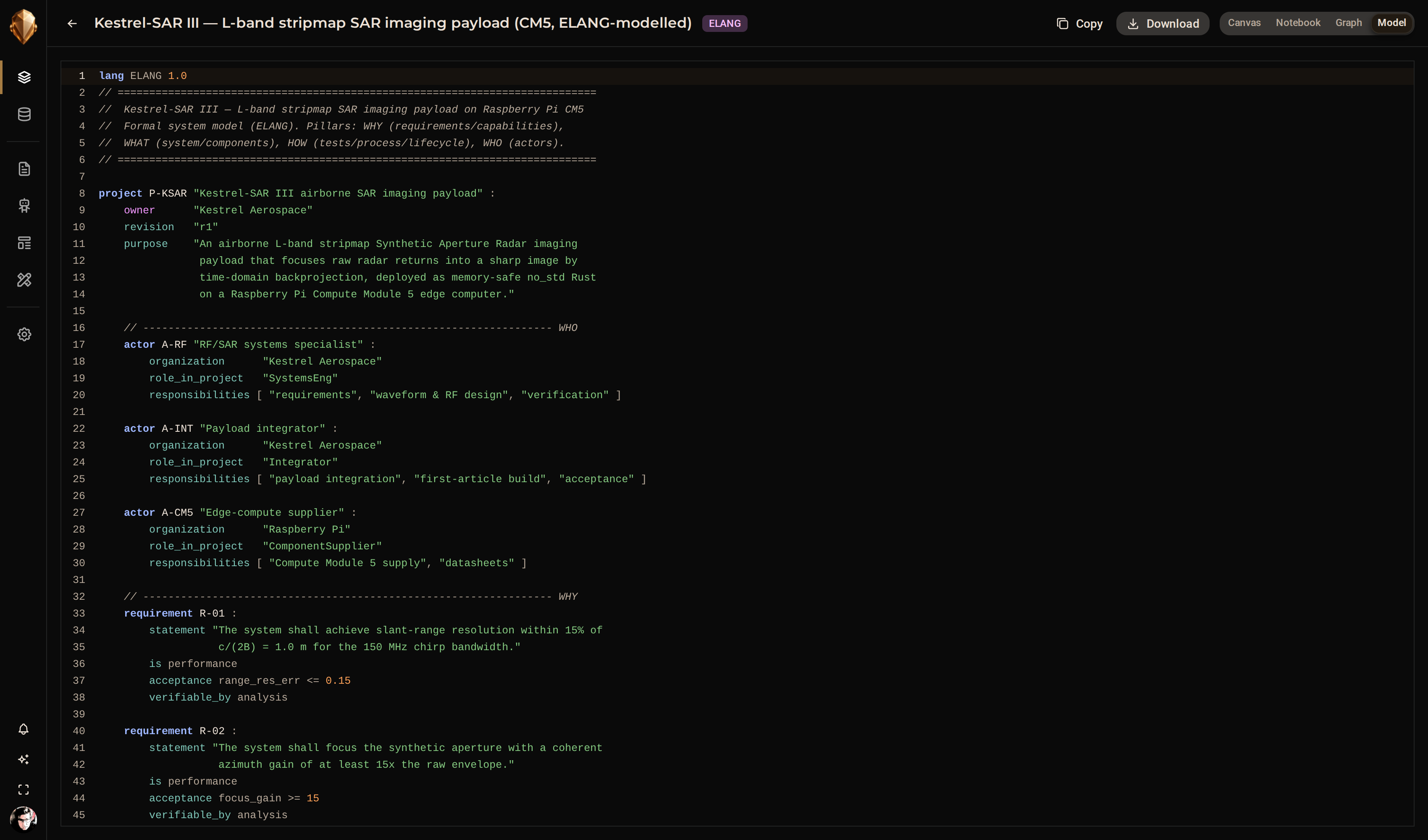
 RDRRF & radar sensing
Embedded Radar Sensing Module
An embedded radar sensing module — the system class the RF/radar recipe covers: a mixed-signal board where spectrum, EMC, environmental and fabrication standards constrain the design as hard as the sensing requirement does.
ELANG reference modelRead the case →


An agent that works the ledger, and stops at the gate
The agent reads the ledger, runs the recipe for the system class, and emits one item per step. What it cannot do is decide it is finished: a human validates every review gate, an autonomy policy bounds which tool classes it may use without asking, and anything that needs approval waits in a queue. The loop does not depend on the agent — a person signs every gate regardless.
- Recipe-driven: one ledger item per step, with the reasoning and tool calls on the record
- Autonomy policy over read / write / browser tool classes — ask, allow or deny, per user
- Anything requiring approval routes to a human queue and auto-rejects after five minutes
- The agent proposes; only user-validated items let it pass a gate
This is engineering software. It does not pretend.
DjiniousEngineering produces a Technical Baseline a person has to sign. So the product refuses to fake: the agent proposes but never passes a gate itself; a requirement resting on UNKNOWN evidence cannot close; a change ripples staleness across everything downstream automatically; and superseding a released item takes a written reason.
- The agent proposes; a human validates every review gate — autonomy never removes that
- Evidence class is enforced: nothing closes a requirement on evidence weaker than its method demands
- Change an item and everything reachable forward along the thread is marked stale
- An UNKNOWN evidence class is shown as unknown, never quietly upgraded to make a gate pass
Bring us a system.
A handful of specifications and one requirement you actually care about. We will take it through the ledger — frame the need, derive verifiable requirements, stand up the ELANG model — and walk a review gate in front of you.